Introduction
The third quarter cooled, and October answered with a fresh run of large deals that will take one to two years to close. In late July the story was concentration: record value, fewest deals in six years. By October the concentration had held, but a second pattern had appeared. Buyers are paying today's prices for positions that will not settle until 2027 or 2028.
The numbers going into October:
- Global M&A reached about $3.9 trillion in the first nine months of 2026, up 28% year over year, according to LSEG. The United States accounted for about $2 trillion of that.
- The third quarter alone came in at about $993 billion, down 41% from the second quarter. It was the first quarter below $1 trillion since the second quarter of 2025, and Reuters linked the slowdown to rising borrowing costs.
- Deals above $10 billion fell from 26 in the second quarter to 10 in the third, the lowest quarterly count of megadeals since late 2024.
- Mergermarket's count tells the same story from a different base. Value rose 27% to $4.44 trillion in the nine months, while deal count fell 1% to 32,419. Deals of $10 billion or more made up a record 35% of value.
- S&P Global Market Intelligence put quarterly deal count below 10,000 for the first time since at least 2024. European deal count fell to a two-year low of 2,819.
- Valuations held better than volumes. S&P's median value-to-EBITDA multiple eased only 2%, to 13.93x.
- Acquirers are not being rewarded. WTW found that dealmakers underperformed companies not doing M&A for the second consecutive quarter.
The three data providers measure differently, so their totals do not match. The direction does: value is concentrated at the top, count is shrinking, and the third quarter was a pause in megadeals rather than a collapse.
1. Industrial AI and the grid: buying the data layer and the factory slot
Schneider Electric to acquire PTC (5 October). Schneider agreed to pay $205 per share in cash, valuing PTC's equity at about $22.6 billion and its enterprise value at about $23.7 billion. The price is a premium of about 42% to PTC's close on 2 October. It is Schneider's largest acquisition to date.
- PTC makes CAD and product lifecycle software. It generated about €2.4 billion of revenue in 2025 at an adjusted EBITA margin of about 40%.
- Schneider targets €250 million of annual cost synergies by year three and about €800 million of revenue synergies.
- Financing is a committed bridge from Morgan Stanley and Société Générale, to be refinanced with about €5 billion to €6 billion of new equity and €16 billion to €17 billion of new debt.
- Closing is expected by the third quarter of 2027.
- Deal logic: Schneider already owns AVEVA for plant operations and has agreed to buy Cognite. PTC adds design and engineering data, so Schneider can offer one data thread from product design to plant operation. That thread is the context industrial AI agents need.
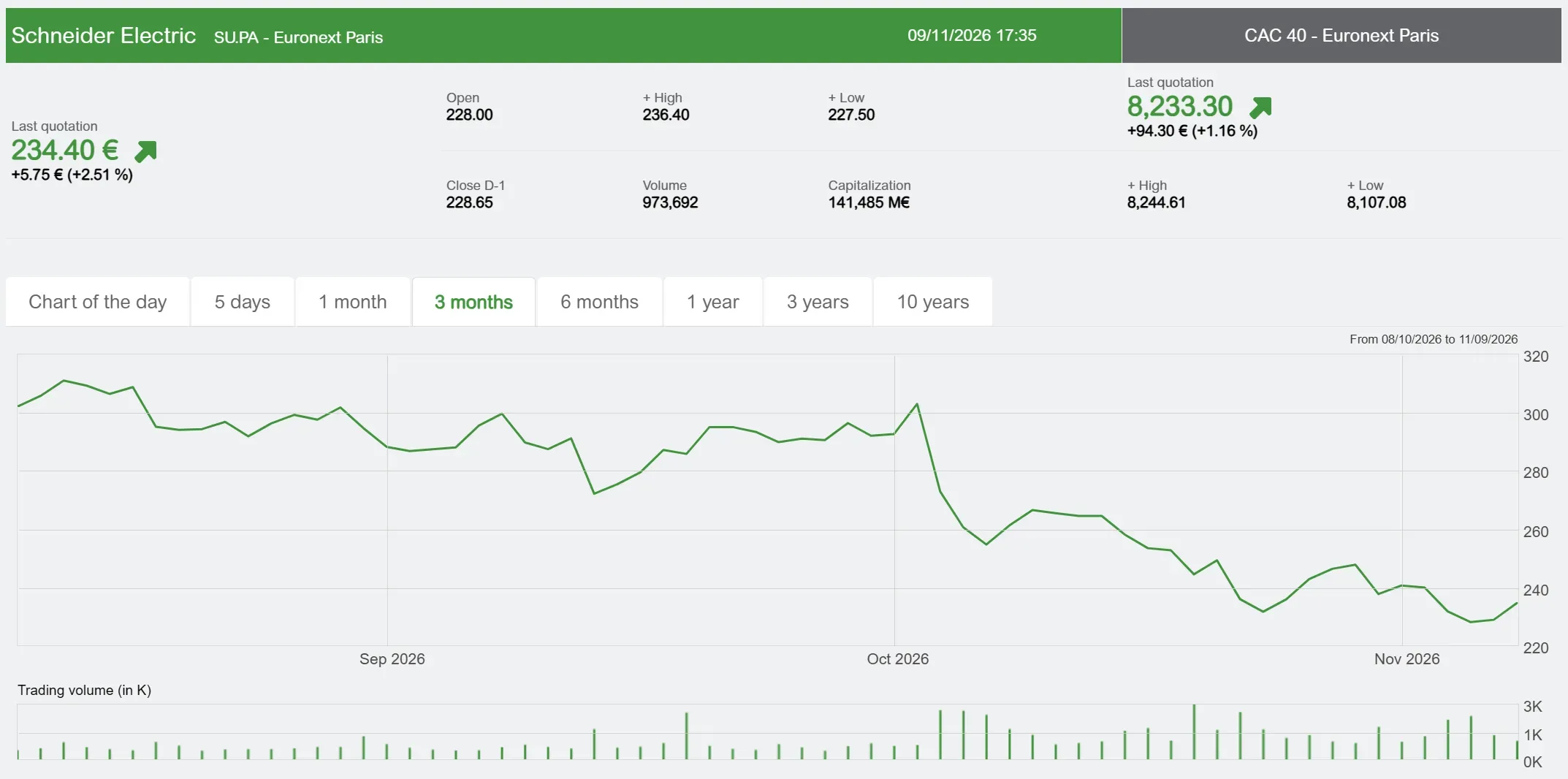
- Risk: the market reaction. Schneider shares fell close to 10% in early Paris trading, removing almost €15 billion of market value. Investors questioned the size and the price, and the equity raise adds dilution to that doubt.
GE Vernova to acquire Trench Group from Triton (28 October). GE Vernova will pay $9 billion for the Berlin-based maker of high-voltage grid equipment. It is GE Vernova's largest acquisition since its spin-off from General Electric.
- Trench supplies bushings, instrument transformers and coils to more than 800 utilities and hyperscalers, from 11 manufacturing sites.
- GE Vernova expects Trench to reach about $1.9 billion of revenue in 2028 at an adjusted EBITDA margin of about 36%. The price is about 13 times expected 2028 adjusted EBITDA before synergies.
- Trench brings about $5 billion of backlog and framework agreements, some running into the next decade.
- Funding is roughly half cash and half debt. Closing is expected in late 2027, subject to regulatory approvals and employee consultations.
- Deal logic: in grid hardware the scarce asset is production capacity, not demand. GE Vernova is buying a supplier, its order book and a new Charlotte plant that plans to start 765-kilovolt production in late 2027.
- Risk: the price is set on 2028 forecasts. If the backlog converts late or at lower margins, the 13x multiple looks expensive on actual earnings.
- For DACH readers: a Berlin-based company is moving from private equity ownership to a US strategic buyer. Trench became independent in April 2024 under Triton's ownership, and its annual revenue has since doubled to more than €1 billion.
Indicators to watch:
- Schneider's equity raise and PTC's shareholder vote;
- the regulatory filings and works council consultations for Trench.
2. Platforms and permanent capital: consolidation with a long fuse
DoorDash to acquire Instacart (29 October). DoorDash will pay $65 per Instacart share, valuing the company at about $17 billion. The price is a 26% premium to Instacart's close on 22 October, the last trading day before media reports.
- At least 75% of the consideration is cash. Shareholders can elect cash, DoorDash stock or a mix, with stock capped at 25% of the total.
- DoorDash will keep the Instacart brand, app and enterprise products. It plans to merge DashPass and Instacart+ into one membership.
- Closing is expected near the end of 2027 or in the first half of 2028. Approvals are needed in the United States, Canada and Israel.
- Deal logic: Instacart brings grocery fulfilment technology, retail media and grocer relationships. DoorDash brings the delivery network. Together they face Amazon, Walmart and Uber in grocery delivery at greater scale.
- Risk: antitrust timing. This is a horizontal combination of two delivery platforms, and the companies have built in a closing window of up to about 20 months. That window is the regulatory risk, priced in advance.
Thrive Holdings to take ADT private (29 October). Thrive Holdings, the permanent-capital vehicle formed by Josh Kushner's Thrive Capital, will pay $10 per ADT share in cash. That values ADT at about $7.6 billion of equity and $15.3 billion of enterprise value, a premium of nearly 46% to the 27 October close.
- Most of the gap between equity and enterprise value is ADT's debt, reported at about $7.8 billion.
- Thrive Holdings raised $2 billion earlier this year from investors including SoftBank, D1 Capital Partners and Altimeter Capital. OpenAI holds a stake in Thrive Holdings, according to several reports.
- Closing is expected in early 2027. ADT withdrew its guidance because of the pending deal.
- Deal logic: Thrive's model is to buy established businesses and rebuild them around AI. ADT becomes the base of a Thrive smart home security business, with AI aimed at monitoring, false alarms and equipment reliability.
- Risk: leverage and thesis together. The buyer takes on a debt-heavy capital structure to fund an operating transformation that has not yet been proven at this scale. Permanent capital removes exit pressure, but it does not remove interest costs.
Indicators to watch: the depth of the US antitrust review of DoorDash/Instacart; ADT's shareholder approval and the debt financing terms.
3. Software and data: paying high premiums to defend against AI disruption
Salesforce to acquire Braze (20 October). Salesforce will pay $47.50 per share in cash, about $5.66 billion of enterprise value. The price is about a 58% premium to Braze's 19 October close of $30.04. Closing is expected in Salesforce's fiscal year 2028, which begins in February 2027.
- Braze serves about 2,770 customers, including Canva, Instacart and Venmo, with real-time engagement across apps, web, email, SMS and WhatsApp.
- Termination fees are $300 million payable by Salesforce and $191.4 million payable by Braze.
- Deal logic: Salesforce is buying a real-time engagement layer its Marketing Cloud lacked. William Blair noted Braze had been displacing Salesforce customers, so the deal also removes a competitor.
- Risk: investors worry that AI erodes demand for traditional software. A 58% premium is a bet that owning the customer data layer protects Salesforce from that shift.
Proofpoint to acquire Varonis (15 October). Thoma Bravo's Proofpoint will pay $49.75 per share in cash, about $6.3 billion, reported as the largest cybersecurity acquisition announced in 2026.
- The price is a 52% premium to the 22 June close of $32.71, before sale rumours, and 17% above the 1 September close of $42.35.
- The deal values Varonis at about 8.4 times trailing revenue and 53 times free cash flow. Closing is expected in the first half of 2027.
- Varonis's filing shows a long negotiation: an opening letter at $36 per share in May, then $43, $46.50 and $49.50, against a Varonis counter of $54, before a "best and final" $49.75. Approaches to other bidders produced nothing better.
- Deal logic: Proofpoint covers people and email, Varonis covers sensitive data. Combined, they sell one platform for data security as companies adopt AI agents.
- Risk: a sponsor-owned platform paying a strategic premium relies on cross-selling to justify it.
LSEG to acquire Octus from Permira (22 October). LSEG agreed to pay $3.535 billion in cash for the credit intelligence provider. That is about 11.8 times Octus's expected 2026 revenue of $300 million. Closing is expected in the first half of 2027.
- Deal logic: LSEG is moving into private and illiquid credit, which it values at $3.5 trillion, and pairs Octus with its Trumid credit trading services.
- Risk: a revenue multiple close to 12x for a data business only works if subscription growth holds. LSEG raised its 2026 guidance on the same day, which gives the deal some cover.
4. Energy: scale in natural gas, paid in stock
EQT to acquire Range Resources (26 October). EQT will issue 0.987 of its shares for each Range share in an all-stock deal. Reported values range from about $13 billion to about $14 billion depending on the share price used. The combined company has a pro forma enterprise value above $50 billion.
- EQT shareholders will own about 73% of the combined company and Range shareholders about 27%.
- The combination produces more than 9 Bcfe per day from nearly 3 million net acres, with more than 30 years of drilling inventory and more than 3,700 miles of midstream infrastructure.
- EQT targets $325 million of annual synergies within two years and sees a path to more than $600 million over the long term.
- EQT says the deal lowers its unlevered free cash flow breakeven to below $2 per MMBtu and projects about $20 billion of cumulative free cash flow over five years at recent strip prices.
- Closing is expected in the first quarter of 2027.
- Deal logic: demand-led gas growth, including LNG, rewards the lowest-cost, longest-life producer. EQT calls the result America's largest and only vertically integrated natural gas producer.
- Risk: the synergy and free cash flow numbers are commodity-dependent. Paying in stock shares that risk with Range holders, but the five-year projection rests on strip prices that can move quickly.
With ADT, this has the shortest closing timeline among October's large deals, and it is the only one paid entirely in stock. Both facts point the same way: there is no acquisition financing to arrange.
5. European banking: control contests move from whether to when
UniCredit and Commerzbank: ECB approval (15 October). The ECB authorised UniCredit to raise its Commerzbank stake above 30%, with no upper limit. UniCredit called it an important milestone and expects the remaining regulatory steps around year-end.
- The exchange offer that closed in July lifted UniCredit's economic stake to about 48%. At completion, UniCredit expects about 50% of voting rights and the ability to take control.
- Commerzbank's response was short: UniCredit remains a shareholder and does not control operations, which stay with Commerzbank's board.
- Berlin still holds a stake reported at 12% to 13% and two supervisory board seats, a legacy of the 2009 rescue.
- Deal logic: unchanged from July. Scale in Germany and a full cross-border bank inside the Banking Union.
- Risk: approval answers the question of ownership, not integration. Germany's conditions on lending, listing and the Frankfurt seat will decide how much of the value case UniCredit can capture.
Intesa Sanpaolo and Monte dei Paschi: the defence fails (29 October). Intesa raised the cash part of its offer by €800 million on 3 October, to €1.25 per MPS share from €1.00. A day later Delfin, MPS's largest shareholder with 17.6%, committed to tender its whole stake.
- On 29 October, MPS shareholders rejected CEO Luigi Lovaglio's defence plan. They voted down share offers for Banco BPM (91.1% of capital present against) and Banca Generali, and rejected the proposed merger with Mediobanca (63.65% against).
- Reuters valued Intesa's offer at about €33 billion on the day of the vote. Earlier October reports put it closer to €35 billion, so the figure moves with Intesa's share price.
- Intesa still needs antitrust approval and enough acceptances from MPS shareholders. Under the plan, Unipol would pay up to €3.5 billion for about 635 MPS branches and the Monte dei Paschi brand.
- Deal logic: control of MPS also brings indirect control of Mediobanca and, through it, its stake in Generali.
- Risk: concentration in Italian banking and the government's stake. Italy's finance ministry still holds 4.86% of MPS and did not take part in the vote.
Indicators to watch: the year-end completion steps and any German government undertaking for Commerzbank; the Intesa offer document, acceptance period and antitrust review for MPS.
6. Regulation: behavioural settlements and buyers named upfront
Paramount and Warner Bros. Discovery close (6 October). The deal that a federal judge put on hold in July, at the request of 12 state attorneys general, closed in October after settlements rather than a trial. Paramount also settled the Writers Guild suit. The combined company now operates as Skydance and trades on the NYSE as SKYD.
- The states announced their settlement on 21 September. The judge approved it on 30 September, the last day before the roughly $7 million daily ticking fee started.
- The consent decree has no divestitures, although California had earlier pushed for structural remedies. It relies on behavioural commitments: minimum theatrical release targets, a ban on selling the Paramount or Warner Bros. lots in California for five years, extra film production spending and an editorial independence board for CNN and CBS News.
- The judge wrote that there are meaningful grounds for disappointment with the decree, and approved it anyway.
- Headline value is about $81 billion for the equity and about $110 billion to $111 billion including debt. Skydance targets at least $6 billion of annual savings within three years.
Kimberly-Clark and Kenvue: EU Phase I clearance with conditions (13 October). The Commission cleared the deal after 35 working days because Kimberly-Clark offered remedies. Its concern was tampons, especially in Czechia, Estonia and Slovakia.
- Kimberly-Clark will exit feminine hygiene in the EEA, selling Kotex (including Lidie), Camelia and Record.
- The Commission approved the buyer, Turkish distributor Dilek, at the same time.
What the pattern says.
- In the United States, July's lesson was that enforcement risk had moved to state AGs. October adds the outcome: state cases can stall a deal for months, but they ended here in behavioural remedies, with a ticking fee as the deadline.
- In Europe, a remedy works best when the buyer is named before clearance. That turns a Phase II risk into a Phase I timetable.
- The Commission's new merger guidelines, published in draft on 30 April, were expected to be finalised in the fourth quarter of 2026. The draft gives more room to scale, resilience and efficiency arguments. Advisers report that the Commission has already started applying parts of it.