There is a stage that most enterprise AI programmes quietly stall at. The pilot worked. The metrics looked promising. The stakeholders nodded. And then, nothing. The initiative sits in a slide deck, referenced occasionally in quarterly reviews, never quite crossing into the operational mainstream.
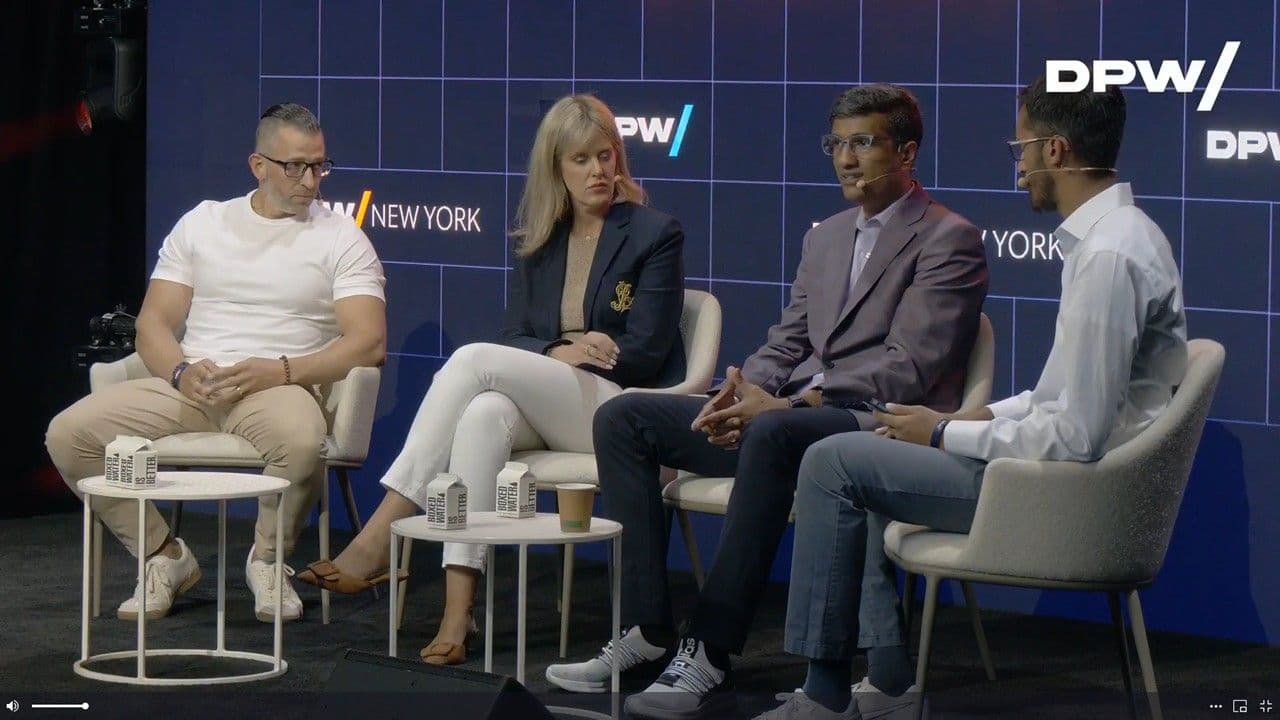
At DPW New York, a panel of procurement leaders from MilliporeSigma, Meta, and Pacific Gas and Electric sat down with Andrew Bartolini of Ardent Partners to answer the question that matters most right now: not whether AI can work in procurement, but what it actually takes to make it stick. The conversation was frank, specific, and unlike much of the conference circuit largely free of vendor framing.
Scale Is Not a Technology Problem
The session opened with a deceptively simple framing question: what separates organisations stuck in experimentation from those actually operationalising AI?
Tracy Avelar, Global Head of Marketing Sourcing at Meta, offered the clearest answer. At Meta, the team uses a framework called UIE, Understand, Identify, Execute. The sequence matters. Understanding means defining business outcomes first, not procurement outcomes. Identifying means narrowing to two or three high-friction workflows with measurable metrics attached. Executing means piloting with incrementality as the standard not dramatic transformation, but statistically significant, demonstrable progress against a committed plan.
"Incrementality," Avelar noted, "is something Meta wears as a badge of honour." In an environment saturated with announcements about AI moonshots, that framing is quietly radical. It suggests that the organisations scaling AI most effectively are the ones who have resisted the pressure to overpromise and instead built a compounding track record of small, provable wins.
John Adjami, Head of IT Business Partnering at MilliporeSigma, added the CIO-side view: pilots are often, by design, geared for success. Controlled data, short timeframes, motivated champions. The cost of scaling in tokens, infrastructure, change management, and governance is frequently unknown until you try. Bringing the CPO and CIO offices together early, on total cost of ownership, gives AI initiatives a far better chance of surviving contact with the enterprise.
The Real Barrier Is Organisational, Not Technical
When Bartolini pushed the panel on which barrier has been hardest to overcome technology, data, or people. the answer was unambiguous.
Adjami was direct: technology is a small element. Data can be engineered and improved continuously. Organisational change is where things succeed or fail. Convincing a category manager with fifteen years of experience and finely tuned instincts to trust an algorithm is genuinely hard. Not because the algorithm is untrustworthy, but because that manager's identity and value have been built on precisely the kind of judgment the AI is now being asked to replicate.
The response to that tension, Adjami argued, is not to minimise it but to meet it directly senior sponsorship, AI embedded in day-to-day work rather than siloed in a project, and giving people the space to learn and experiment without fear of displacement.
Avelar pushed further: culture eats strategy every single day. The organisations that are moving fastest are not just deploying tools they are redesigning workflows, restructuring teams, and redefining what the function itself looks like. At Meta, that means shifting away from traditional category sourcing teams toward category partners focused on complex problems, a product team within sourcing that codes and builds alongside engineers, and an innovation function that didn't exist two years ago. Eighty percent of Meta's organisation is already classified as AI-native a metric the company tracks deliberately, not incidentally.
Aditya Ramani, Sourcing Director at PG&E, offered a grounding counterpoint: there is a lot of FOMO in how AI roadmaps get built. Boards and CEOs see the news cycle and want their organisation on the front page of the trend. The discipline, Ramani argued, is defining your roadmap against your company's actual vision and growth trajectory not against what a competitor announced last quarter. That discipline is also the hardest thing to defend when managing upward.
Human in the Loop - How Many, Not Whether
The panel's discussion on agentic AI and risk produced one of the session's sharpest insights. The question of whether humans should remain in the loop, Ramani noted, is largely settled at PG&E, a regulated California utility operating under some of the most detailed compliance requirements in the country. The real question is how many humans, and at which points.
His framing was practical: a supplier onboarding agent that checks cyber, privacy, and risk can reduce the number of humans required to review each case, but a human validating the agent's score and authorising the move forward remains essential. An invoice validation agent processing at volume can surface exceptions for human judgment without requiring human review of every line.
Adjami reframed the same point through a process lens: organisations that have struggled with AI agents have often done so because they lifted and shifted a broken process into a new system and blamed the AI when the output was poor. What those deployments actually revealed was the underlying inefficiency, the same way Google's early search algorithms forced the web to rethink how pages were structured. The AI did not create the problem. It made it visible.
Avelar's summation was clean: machines can do the work. Judgment, discernment, and taste remain human. In procurement specifically, that means the relationship layer, the influence, the stakeholder partnerships, the seat at the table is not at risk. It is the foundation that makes everything else valuable.
The Agentic Use Cases Worth Watching
Each panellist named the use case they believe has the most near-term traction:
Aditya Ramani - Invoice Validation and Contract Obligation Management.
At PG&E, invoice volume is growing alongside spend currently around $15 billion annually and rising. Invoice validation in the absence of fully digitalised contracts and invoices is labour-intensive and error-prone. AI can process at scale, surface exceptions, and reduce the human review burden significantly. On the contract side, post-award obligation monitoring particularly in capital construction, where 300-page contracts are the norm is an area where AI already performs well and the ROI case is straightforward.
John Adjami - Payables Optimisation and Supply Chain Risk Radar.
At MilliporeSigma, a near-term priority is working capital optimisation through more intelligent payment timing moving beyond sweep-based payment proposals toward AI-modulated scheduling that can unlock meaningful savings by shifting payment dates by days, not weeks. Alongside that, the team has built an internal risk tool called Radar that crawls benchmarking data and supplier intelligence sources to surface risk signals for the CPO already live in one sector and being scaled across the other two.
Tracy Avelar - Autonomous Supplier Recommendation. Meta is building a recommended supplier program that autonomously vets suppliers across three dimensions, rates, risk, and performance, using skill agents built for each. Suppliers submit rate cards that are evaluated against benchmarks with automated feedback, risk scores are generated internally, and suppliers that clear all three thresholds are automatically surfaced to requesters at the right point in the buying journey. It is, in effect, a dynamic preferred supplier programme that operates without manual curation.
What CPOs Should Prioritise in the Next Twelve Months
The session closed with each panellist offering a single priority for CPOs trying to move from isolated pilots to enterprise-wide impact.
Ramani's answer was grounded in PG&E's operating philosophy: draw a direct line between your AI use case and the people doing the work. The company's CEO frames it as AI by the people, for the people. Every use case needs to connect back to that to joy at work, to enabling frontline workers to do meaningful things, not just to efficiency metrics on a dashboard.
Avelar's answer was organisational: culture and redesign, executed with empathy. At Meta, AI proficiency is now embedded in performance expectations at every level, with clear definitions of what good looks like by seniority. The goal is to make it a skill that is developed and recognised, not a burden that is imposed.
Adjami's answer was systemic: accountability at the top, storytelling that explains the why, AI champions embedded across the organisation, and a close working relationship between the CPO and CIO offices especially as the cost of tokens and infrastructure becomes better understood at scale. Prompting as a skill, he argued, deserves the same investment as any other professional capability. A category manager who can interrogate a contract for obligation gaps or pricing anomalies using AI is a fundamentally different kind of professional. That upgrade is worth engineering deliberately.
The Pattern Underneath
What united the three perspectives across a German science and technology conglomerate, a global social media platform, and a 125-year-old California utility was not a shared technology stack or a common use case. It was a shared sequence: fix the process before deploying the agent, earn organisational trust before expanding scope, and measure what matters rather than what impresses.
The organisations scaling AI in procurement are not the ones with the most sophisticated models. They are the ones that treated the change management problem with the same rigour they applied to the technical one.