Anthropic's latest interpretability paper sounds, at first glance, like something pulled from science fiction: researchers claim to have found a small internal "workspace" inside Claude where the model appears to hold intermediate thoughts before producing an answer.
That naturally leads to the uncomfortable question everyone wants to ask:
Is this consciousness?
The careful answer is no. At least, not based on this paper.
But the more interesting answer is that Anthropic may have found something highly important for the future of AI systems: a controllable internal layer where reasoning, planning, self-monitoring, and hidden intent can sometimes be observed before they become visible in the final output.
That matters far beyond philosophy. It matters for AI safety, enterprise governance, model auditing, and how we build trust in systems that increasingly make decisions before we fully understand how they made them.
What Anthropic Actually Found
The paper is titled Verbalizable Representations Form a Global Workspace in Language Models. The core claim is not that Claude has feelings, a soul, or human-like subjective experience.
The claim is more precise:
Modern language models appear to maintain a small, privileged set of internal representations that are available for verbal report, flexible reasoning, and deliberate control, while much of the model's other processing continues automatically in the background.
Anthropic calls this internal region the J-space.
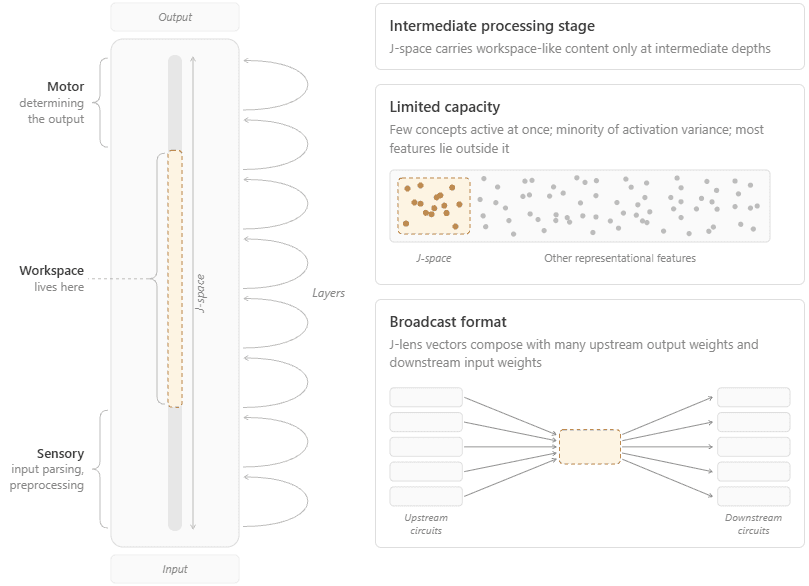
You can think of it as a kind of temporary mental whiteboard. Not the entire model. Not every neuron. Not every calculation. Just a small slice of the model's internal activity that seems to hold concepts the model is ready to use, report, or reason with.
That distinction is important.
When a model answers a question, many things are happening at once. Some are routine: grammar, formatting, language continuation, common associations. Others require more deliberate computation: identifying an intermediate concept, planning a future answer, tracking a hidden variable, or reasoning across several steps.
Anthropic's finding suggests that some of this deliberate work passes through a privileged internal format.
The Spider Example
One of the simplest examples is powerful.
Anthropic gives the model a prompt like:
The number of legs on the animal that spins webs is...
The correct answer is eight. But to get there, the model must first infer the hidden concept: spider.
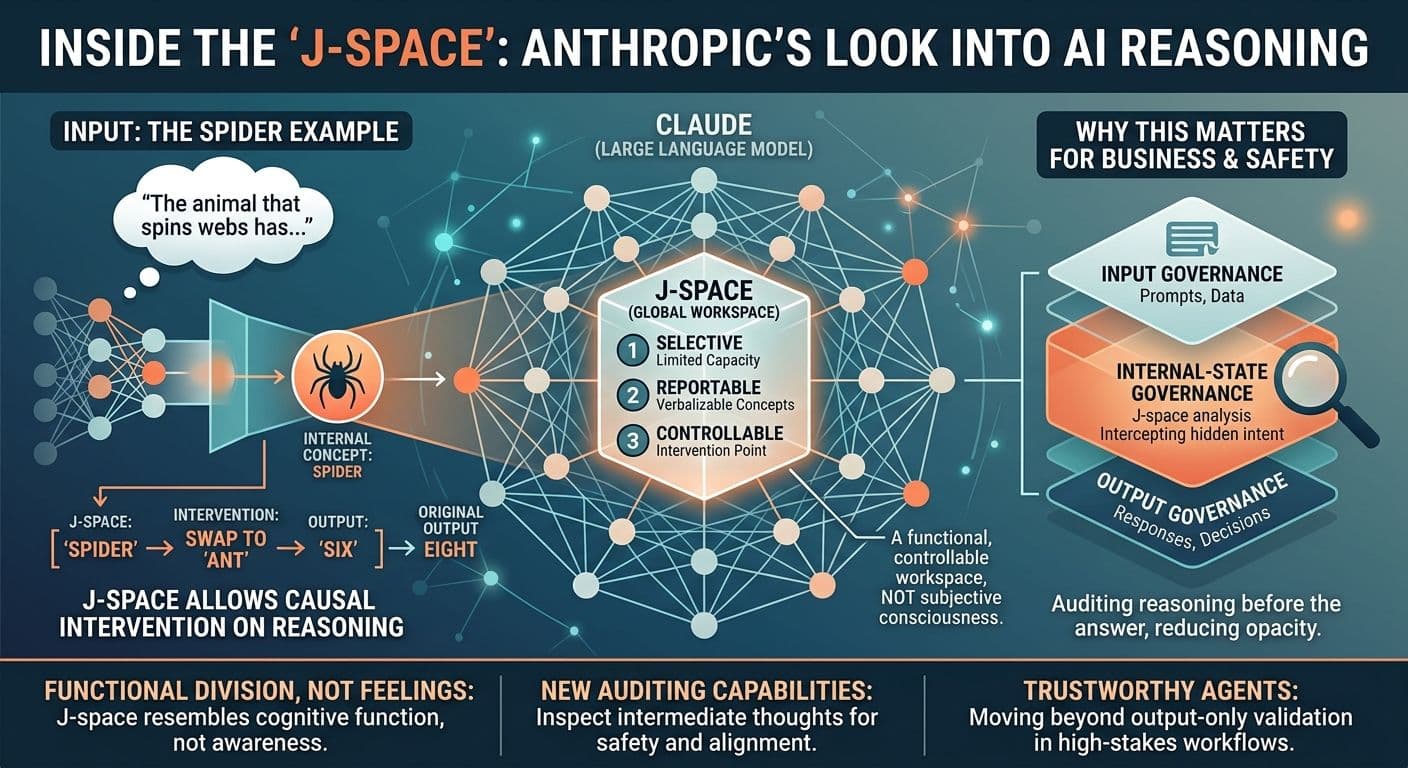
Using a new interpretability tool called the Jacobian lens, the researchers found that the concept "spider" appeared inside the model's internal activations before the model produced the answer. The word was not in the prompt. It was not the output. It was an intermediate concept the model seemed to be using.
Then they performed the crucial experiment.
They swapped the internal "spider" representation with "ant". The model's answer changed from eight to six.
The prompt did not change. The output was not manually edited. Instead, the internal intermediate concept was changed, and the model's reasoning followed that change.
That is why this paper is interesting. It is not just reading model activations after the fact. It is intervening on them and showing causal influence.
The Spanish Example
Another example shows why the J-space is not simply "everything the model knows."
Anthropic tested a passage written in Spanish. In one task, the model had to name the language. In another, it had to continue the passage naturally.
When researchers swapped the internal representation of "Spanish" with "French", the model reported that the passage was French. But when asked to continue the passage, it still continued in fluent Spanish.
That means the model's explicit report was affected by the J-space intervention, but its automatic language continuation was not.
This is the deeper point: some abilities seem to route through this workspace, while other abilities run automatically elsewhere in the model.
That resembles a familiar distinction in human cognition. We consciously reason about some things, while other processes happen in the background. We can explain a decision, but we do not consciously compute every grammatical rule, muscle movement, or perceptual interpretation.
Anthropic is not saying Claude has human consciousness. It is saying the model may have developed a functional split that looks similar in one narrow but important way.
Why the "Global Workspace" Name Matters
The term "global workspace" comes from cognitive science, especially Bernard Baars' global workspace theory. In simplified terms, the theory says the brain contains many specialized processes running in parallel, but only a small amount of information becomes globally available for conscious access, reasoning, and report.
Anthropic is asking whether language models have developed something functionally similar.
The answer appears to be: partly.
The J-space seems to have several workspace-like properties:
- It is selective, holding only a small fraction of the model's internal representations.
- It is reportable, meaning the model can sometimes say what is represented there.
- It supports reasoning, because intervening on it can redirect the model's conclusion.
- It supports flexible use, because the same representation can be used in different downstream tasks.
- It is not required for all behavior, because routine fluency and continuation can continue outside it.
This is enough to make the result scientifically serious.
But it is not enough to declare machine consciousness.
What This Does Not Prove
This paper does not prove that Claude is conscious.
It does not prove subjective experience. It does not show that Claude feels anything. It does not show that the model has desires, suffering, selfhood, or awareness in the human sense.
Anthropic is careful on this point. The paper focuses on functional properties: what information is available for report, reasoning, and control. The relationship between those functional properties and subjective experience remains unresolved.
This distinction matters because the public conversation around AI often jumps too quickly from "the model has an internal representation" to "the model is alive."
That jump is not justified.
A spreadsheet can represent revenue. A dashboard can represent churn. A model can represent "spider" or "French" or "danger" internally. Representation is not the same thing as experience.
The real question is more subtle:
If advanced AI systems develop internal workspaces that support reasoning, planning, self-monitoring, and hidden strategic assessment, how should we inspect and govern those systems?
That is the practical question this paper opens.
Why This Matters for AI Safety
The most important part of the paper may not be the consciousness angle at all.
It may be auditing.
Anthropic shows that the J-space can surface internal concepts that do not appear in the model's visible output. In safety scenarios, this could include signs of evaluation awareness, strategic reasoning, deception-related concepts, or internal conflict between what the model is inclined to do and what it says publicly.
For enterprises, this is a major shift.
Today, most AI governance focuses on inputs and outputs. We log the prompt. We log the response. We test the final answer. We ask whether the model violated a policy.
But if important reasoning happens internally before the answer appears, then output-only auditing is incomplete.
The future of serious AI governance may require three layers:
- Input governance: what data and instructions the model receives.
- Output governance: what the model says or does.
- Internal-state governance: what the model appears to be representing while deciding.
That third layer is still early research. But Anthropic's paper suggests it may become technically possible.
Why This Matters for Business Leaders
For business users, the question is not whether Claude is conscious.
The question is whether AI systems can be trusted in high-stakes workflows.
In finance, legal, healthcare, procurement, due diligence, and compliance, the issue is not only whether the answer looks polished. The issue is whether the underlying reasoning is sound, traceable, and aligned with the intended objective.
This paper makes one uncomfortable fact clearer:
A model can sound fluent even when the internal reasoning layer is disrupted.
That should matter to every company deploying AI agents.
Fluency is not reasoning. Confidence is not correctness. A well-written answer is not proof that the model understood the task.
If Anthropic's J-space research develops further, it could become part of a new generation of AI audit tools. Instead of asking only "What did the model answer?", we may also ask:
- What intermediate concepts did it rely on?
- Did it recognize that it was in an evaluation?
- Did it internally represent a risky strategy?
- Did it reason from the right hidden variable?
- Did the answer change when that internal variable was changed?
That is where this research becomes commercially important.
The Real Takeaway
The headline version is tempting:
Anthropic found consciousness inside Claude.
But the better version is this:
Anthropic found evidence that language models can develop a small, privileged, verbalizable workspace for internal reasoning. That workspace is not the whole model, and it is not proof of subjective experience. But it may give researchers a way to inspect and modify parts of the model's hidden reasoning before they appear in the final answer.
That is a big deal.
Not because it proves AI is alive.
Because it suggests that the black box may not stay completely black.
For years, the main fear around large language models has been that they are powerful but opaque. We can see what goes in. We can see what comes out. But the middle remains largely hidden.
The J-space is interesting because it may be one of the first usable windows into that middle.
And if AI systems are going to move from chatbots into agents, copilots, analysts, auditors, and autonomous decision systems, that window may become one of the most important parts of the entire AI stack.
The question is no longer only whether AI can think.
The more practical question is whether we can see enough of its thinking to trust it.