For the last two decades, enterprise software has been sold around one simple unit: The seat.
One employee. One license. One monthly fee.
That model worked reasonably well when software helped humans do work. But agentic AI changes the equation. If one finance analyst using an AI workflow can produce the output that previously required five people, why should the company pay for five separate AI seats? And more importantly, why should the company allow the most valuable part of the workflow to sit inside someone else’s application layer?
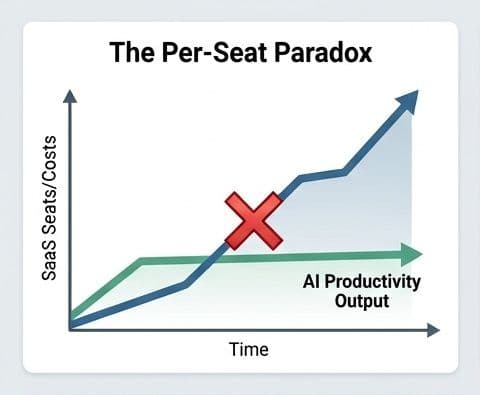
This is the per-seat paradox.
The more efficient AI makes the organization, the less logical per-seat pricing becomes. A CFO who buys AI purely as another SaaS subscription may feel they are modernizing the finance function. In reality, they may be creating a new margin leak, where productivity gains are captured not by the enterprise, but by software vendors.
This is not a theoretical issue. AI business tools already cluster around familiar per-user economics. ChatGPT Business is priced at $25 per user per month when billed monthly, or $20 per user per month when billed annually, according to OpenAI’s own help documentation. Microsoft has also marketed Microsoft 365 Copilot as a $30 per user per month add-on for business customers.
For a 500-person finance, accounting, FP&A, tax, controllership, treasury, and shared services organization, that means a basic AI seat rollout can quickly become a $120,000 to $180,000 annual commitment before the company has automated a single end-to-end workflow.
The problem is not that these tools have no value. Many of them are useful. The problem is that a seat is the wrong economic unit for enterprise AI.
The better unit is the workflow.
And the better architecture is not a collection of disconnected AI subscriptions. It is a private, model-agnostic orchestration layer owned by the enterprise.
The Real Shift: From AI Apps to AI Infrastructure
The first wave of corporate AI adoption was application-led. Teams bought copilots, chat interfaces, writing assistants, meeting summarizers, research tools, Excel helpers, document processors, and finance-specific AI products.
That phase was necessary. It helped employees understand what generative AI could do.
But the second wave will be different.
The second wave is infrastructure-led.
Forward-thinking finance teams are now asking a more serious question:
Should we keep buying AI seats, or should we build an internal AI workflow layer that connects our data, our controls, our processes, and the best available models?
That question matters because most enterprise value in AI does not come from chatting with a model. It comes from orchestrating a process.
A finance close workflow does not need a generic chatbot. It needs data extraction, trial balance mapping, variance detection, reconciliation logic, control checks, commentary drafting, workflow approval, audit trail, and output formatting.
A due diligence workflow does not need an isolated AI assistant. It needs document ingestion, VDR indexing, revenue bridge analysis, customer concentration review, contract risk extraction, adjusted EBITDA support, and management presentation drafting.
A treasury workflow does not need another subscription. It needs bank statement ingestion, cash visibility, FX exposure analysis, liquidity forecasting, covenant monitoring, and exception escalation.
These are not “AI chat” problems. These are orchestration problems.
Why Vendor Lock-In Is a Financial Risk
The CFO should look at AI vendor lock-in differently from traditional software lock-in.
In traditional SaaS, lock-in usually means the cost of moving data, retraining users, or reimplementing workflows.
In AI, lock-in is more dangerous because the underlying intelligence layer is changing constantly. Models improve, prices change, context windows expand, latency changes, reasoning quality changes, privacy options change, and new open-weight models appear.
If your finance workflow is hardcoded into one vendor’s model, you inherit that vendor’s pricing, roadmap, latency, outages, and model limitations.
That is not a technology decision. It is a financial exposure.
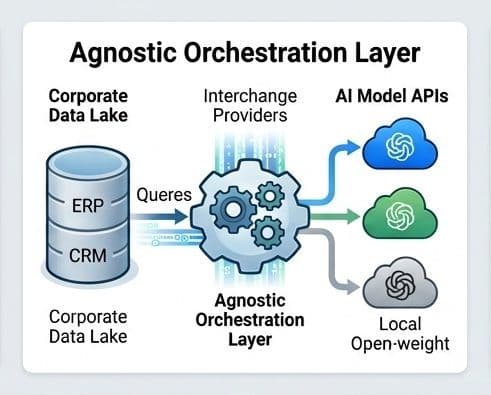
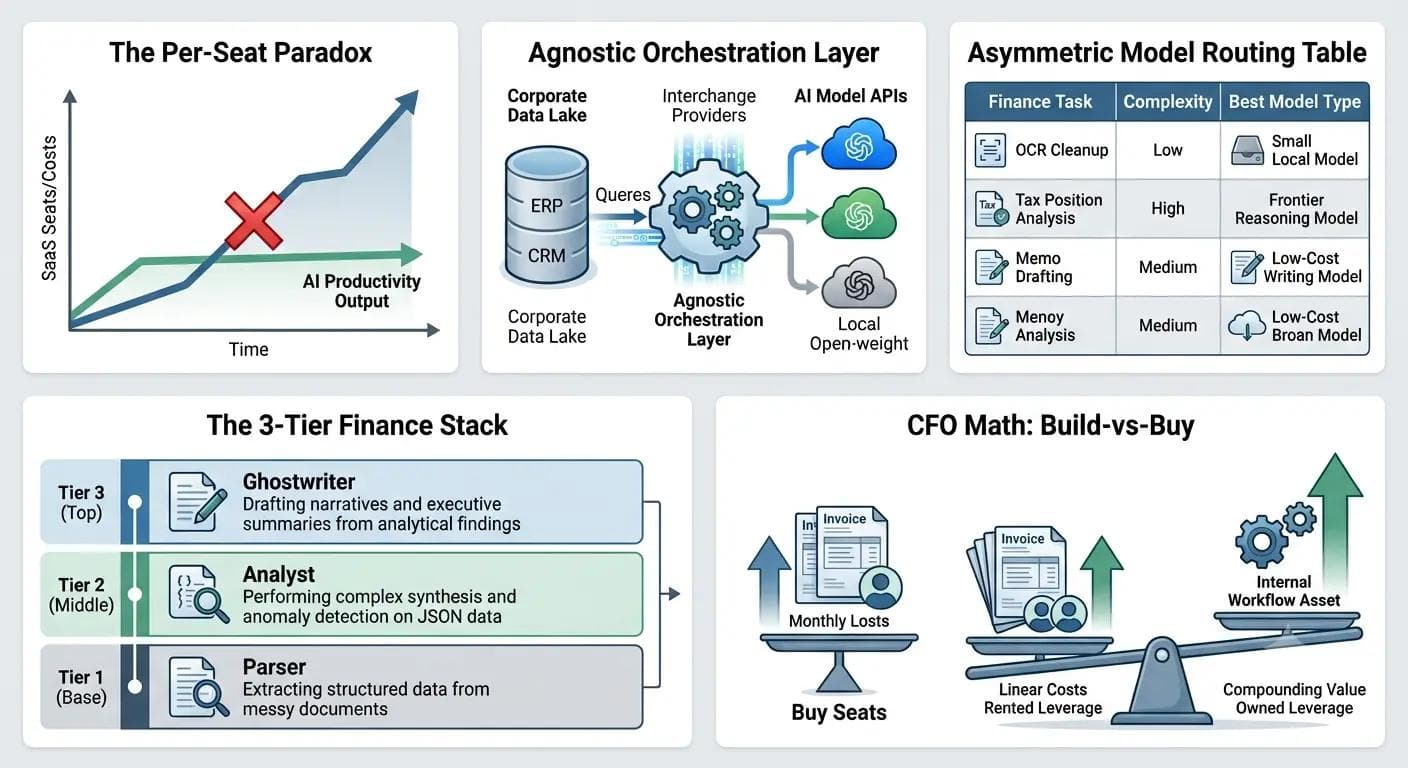
A model-agnostic architecture solves this by separating four layers:
- The corporate data layer
- The orchestration and workflow layer
- The model routing layer
- The user experience layer
The model becomes replaceable. The workflow remains yours.
This is where frameworks such as LangChain and LlamaIndex become strategically relevant. LangChain’s documentation states that it supports major model providers through standard interfaces, allowing teams to swap providers without rewriting application logic. LlamaIndex positions itself as a data framework for LLM applications, with connectors for data sources and formats such as APIs, PDFs, documents, and SQL.
The architectural point is simple: do not let the model own the workflow. Let the workflow decide which model to use.
The Core Idea: Asymmetric Model Routing
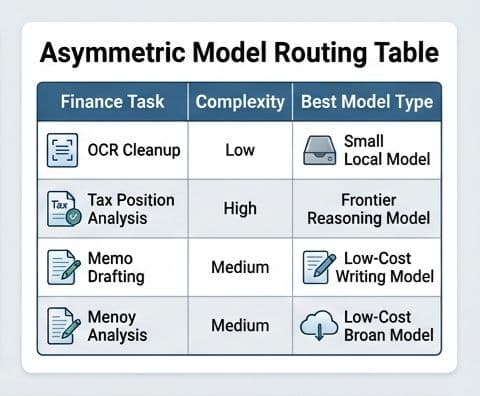
The biggest mistake companies make with AI is sending every task to the most powerful model.
That feels safe. It is also financially lazy.
Not every finance task requires frontier reasoning. Some tasks are repetitive, structural, and high volume. Others require deep judgment. Others only require polished writing.
A smart finance AI architecture routes each task to the cheapest model that can complete it reliably.
This is asymmetric model routing.
Instead of one model doing everything, the workflow uses different models for different jobs.
A simple example:
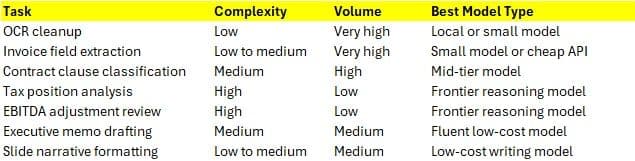
This is how finance teams should think about AI economics. Not “which model is best?” but “which model is sufficient for this step?”
The Three-Tier Finance AI Architecture
A practical enterprise finance architecture can be designed around three AI tiers.
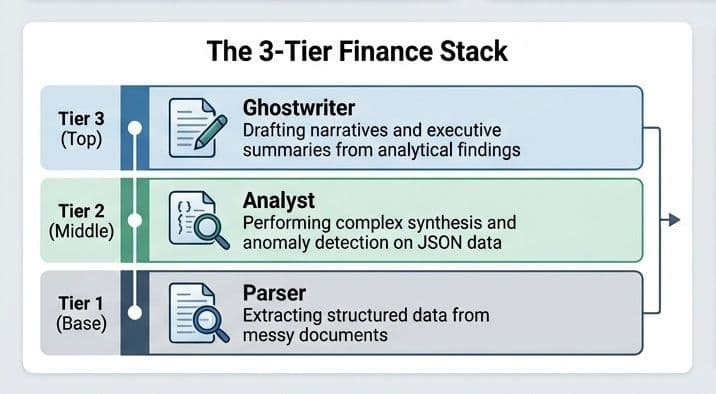
Tier 1: The Parser
The Parser handles high-volume, low-complexity work.
Its job is to read raw financial data and convert it into structured, controlled, machine-readable information.
Typical tasks include:
- OCR cleanup
- PDF parsing
- Trial balance extraction
- Invoice field extraction
- Metadata tagging
- Supplier name normalization
- Period detection
- Basic account mapping
- Document classification
- Conversion into structured JSON
This is where many companies waste money.
They send raw, messy, uncompressed documents directly into expensive frontier models. That is like hiring a senior partner to staple papers.
For many finance workflows, the raw data layer is huge. Thousands of invoices. Hundreds of contracts. Trial balances across subsidiaries. Board packs. Audit schedules. Tax workpapers. ERP exports. Bank statements. Vendor master files.
Most of this does not require deep reasoning. It requires structured extraction.
That makes it a strong candidate for local or small models, especially where privacy matters. Meta’s Llama 3.2 release included lightweight 1B and 3B text-only models designed to fit on select edge and mobile devices, making local or private deployment more realistic for certain controlled tasks.
For CFOs, the strategic point is not that every company should run local models immediately. The point is that raw financial data should not automatically be shipped to the most expensive external model.
The Parser compresses the problem.
It turns messy input into structured JSON.
That structured JSON is what the next layer should reason on.
Tier 2: The Analyst
The Analyst handles low-volume, high-complexity work.
This is where frontier reasoning models earn their cost.
The Analyst does not need to read every raw invoice line if the Parser has already converted the data into a clean structure. It needs to reason across the structured evidence.
Typical tasks include:
- Variance analysis
- EBITDA adjustment review
- Revenue recognition assessment
- IFRS to local GAAP reconciliation
- Working capital trend analysis
- Customer concentration risk review
- Contractual risk synthesis
- Covenant analysis
- Tax exposure analysis
- M&A due diligence red flag detection
- Anomaly explanation
This is where the enterprise should spend money carefully.
Current API pricing shows why routing matters. OpenAI’s GPT-5.5 standard short-context pricing is listed at $5 per million input tokens and $30 per million output tokens, while GPT-5.4-mini is listed at $0.75 per million input tokens and $4.50 per million output tokens. Anthropic’s pricing page lists Claude Sonnet 4.6 at $3 per million input tokens and $15 per million output tokens, and Claude Haiku 4.5 at $1 per million input tokens and $5 per million output tokens.
These numbers will change over time, but the pattern will remain: different models have different cost and capability profiles.
The Analyst tier is where you use the expensive reasoning model only after the data has been compressed, cleaned, and structured.
That is the key.
Do not ask a premium model to read noise. Ask it to reason on evidence.
Tier 3: The Ghostwriter
The Ghostwriter handles medium-volume, low-to-medium-complexity communication work.
Its job is not to decide. Its job is to communicate.
Typical tasks include:
- Executive summaries
- Board memo drafting
- Monthly finance commentary
- Audit committee updates
- FP&A narrative packs
- Due diligence issue summaries
- CFO briefing notes
- Slide storyline support
- Tone adjustment
- Formatting to corporate templates
This is another area where companies waste money.
A frontier reasoning model may be excellent at complex logic, but it is often overkill for writing a polished memo from already-approved bullet points.
Once the Analyst tier has produced the insight, the Ghostwriter tier can turn it into a readable, executive-ready narrative using a cheaper fluent model.
The Ghostwriter should not invent the conclusion. It should express the conclusion.
That distinction is important for finance governance.
The Analyst reasons. The Ghostwriter writes. The human approves.
A Practical Workflow Example: Quarterly Finance Review
Imagine a multinational company preparing a quarterly finance review across 25 subsidiaries.
The raw input includes:
- Trial balances
- Management accounts
- ERP exports
- Commentary files
- Bank statements
- Open AR and AP reports
- Headcount data
- Revenue schedules
- Lease schedules
- Intercompany balances
- PDF board packs
A traditional AI rollout may give every finance user a general-purpose AI seat and expect productivity to emerge organically.
A workflow-led approach is different.
The orchestration layer runs the process.
First, the Parser ingests the raw files, detects the entity, currency, period, account structure, and file type. It extracts the relevant fields and converts them into structured JSON.
Second, the Analyst reviews the structured data. It identifies revenue movement, gross margin pressure, working capital changes, unusual accruals, intercompany mismatches, FX effects, and potential classification issues.
Third, the Ghostwriter drafts the CFO pack commentary. It converts the analytical findings into a readable executive narrative with clear sections, issue flags, and recommended follow-ups.
The finance team does not ask a chatbot to “analyze the quarter.”
The finance team runs an AI-enabled finance review workflow.
That is a very different operating model.
The CFO Math: Seats Versus Workflows
Let us make the economics practical.
A 500-user AI seat rollout at $25 per user per month costs $12,500 per month. At $30 per user per month, it costs $15,000 per month. Annually, that is $150,000 to $180,000 before implementation, change management, controls, or integration effort.
Now compare that with a workflow architecture.
Assume a monthly finance automation pipeline processes:
- 100,000 finance documents
- 200 million raw input tokens equivalent
- 50 million extracted output tokens
- 5 million compressed reasoning input tokens
- 1 million reasoning output tokens
- 10 million writing input tokens
- 2 million writing output tokens
If everything is sent to a flagship model, cost grows quickly. If the workflow is routed intelligently, the cost profile changes.
The raw parsing layer can be handled locally or with a very low-cost model. The reasoning model is used only on compressed, structured evidence. The writing model is used only for narrative production.
This is why model routing matters.
The exact numbers will vary by provider, region, usage tier, caching, batch processing, data residency, and enterprise discount. OpenAI’s pricing page, for example, distinguishes standard, batch, flex, and priority pricing, and Anthropic also recommends model selection, prompt caching, batch operations, and usage monitoring as cost optimization strategies.
But the direction is clear.
Per-seat pricing charges based on how many people may use AI.
Workflow pricing charges based on how much work AI actually performs.
For CFOs, that is the difference between buying access and owning leverage.
The Privacy Argument: Keep the Raw Layer Close
Cost is only half the story.
The bigger issue is data control.
The most sensitive finance data usually lives at the raw layer:
- Supplier invoices
- Payroll-related accruals
- Tax workpapers
- Bank details
- Customer contracts
- M&A documents
- Board materials
- Legal provisions
- Unreleased financial results
- Forecast files
If a company sends all raw data directly to external AI applications, it increases privacy, governance, and audit complexity.
A model-agnostic architecture allows a better design.
The raw data layer can remain inside the enterprise perimeter. The Parser can run locally, in a private cloud, or inside a controlled environment. Only structured, minimized, and policy-approved data is routed to external models when needed.
This is especially important in finance because not every task needs the full document. A reasoning model may only need specific extracted fields, redacted clauses, variance movements, or summarized schedules.
The principle is simple:
Keep raw data close. Send only what the task requires.
This is not just a technical design choice. It is a control design choice.
Why Finance Is the Natural Starting Point
Finance is one of the best functions for model-agnostic AI orchestration because finance work has three characteristics.
First, finance has high document density. Invoices, contracts, reports, reconciliations, policies, schedules, trial balances, and presentations all create repetitive information work.
Second, finance has clear control requirements. Every number must be traceable. Every adjustment needs support. Every conclusion must survive review.
Third, finance has repeatable workflows. Monthly close, forecast cycles, board reporting, audit preparation, due diligence, tax provisioning, and cash reporting repeat again and again.
That combination makes finance ideal for internal AI workflow assets.
The company does not need a different AI app for every finance task. It needs a common orchestration layer that can support many workflows.
Once the layer exists, new workflows become faster to build.
Today it may support monthly commentary.
Tomorrow it may support contract review.
Next quarter it may support M&A diligence.
After that it may support audit readiness, tax review, treasury forecasting, or procurement analytics.
This is why the orchestration layer becomes a compounding asset.
Build Versus Buy Has Changed
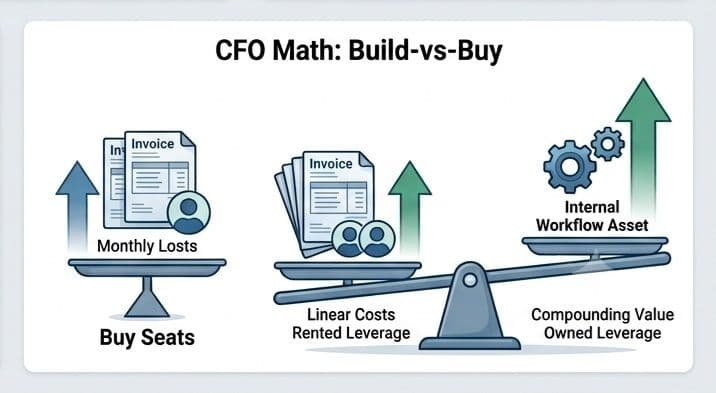
Historically, buying SaaS was usually better than building internal software.
The vendor had scale. The vendor had engineering depth. The vendor could spread development cost across customers. The enterprise could avoid maintenance.
That logic still applies to many systems of record.
But AI workflows are different.
The most valuable workflow logic is specific to the company:
- Its chart of accounts
- Its ERP structure
- Its controls
- Its reporting calendar
- Its management style
- Its materiality thresholds
- Its risk appetite
- Its acquisition strategy
- Its business model
- Its board reporting format
- Its finance operating model
A generic AI application can help around the edges. But the core workflow logic belongs inside the enterprise.
That does not mean companies should build everything from scratch. They should still use commercial models, cloud services, vector databases, document parsers, observability tools, and security platforms where it makes sense.
But they should own the orchestration layer.
The build-vs-buy calculation has flipped at the workflow layer.
Buy the model access.
Buy the infrastructure components where appropriate.
But build the enterprise workflow brain.
The New Finance AI Stack
A sovereign finance AI stack should include:
- Data connectors
ERP, EPM, CRM, data warehouse, contract repository, VDR, SharePoint, email, PDF stores, and finance folders. - Document intelligence
OCR, parsing, layout understanding, entity extraction, metadata tagging, and version tracking. - Policy and control layer
Data classification, redaction rules, access rights, approval flows, logging, and audit trails. - Model router
Rules that decide whether a task goes to a local model, low-cost model, mid-tier model, or frontier reasoning model. - Workflow engine
Agentic process logic for close, reporting, diligence, audit support, tax, treasury, and FP&A. - Human review layer
Finance users approve conclusions, override exceptions, and sign off outputs. - Output layer
Excel, PowerPoint, PDF, board memo, dashboard, ticket, or system update. - Observability and cost monitoring
Token usage, model performance, latency, failure rates, exception types, and cost per workflow.
This stack turns AI from a subscription into an operating capability.
The Strategic Takeaway
The future of AI in finance will not be won by the company with the most AI seats.
It will be won by the company that owns the most valuable workflows.
Per-seat AI is useful for experimentation. It gives employees access. It builds familiarity. It helps the organization learn.
But serious enterprise value comes from workflow ownership.
A finance team that owns its orchestration layer can choose the best model for each task, control where data flows, reduce unnecessary token spend, preserve auditability, and avoid dependency on one vendor’s roadmap.
A finance team that only rents seats is always downstream of someone else’s workflow design.
That is the real issue.
In the age of AI agents, the winning companies will not simply use AI. They will operationalize it.
They will not send every problem to one expensive model. They will route work intelligently.
They will not let raw financial data flow blindly into external tools. They will control the data path.
They will not buy disconnected AI apps and hope productivity appears. They will build internal AI workflow assets.
The CFO question is no longer:
How many AI seats should we buy?
The better question is:
Which finance workflows should we own?
Because once AI becomes agentic, the seat is no longer the center of value.
The workflow is.