Exploring What Conversational AI Could Become
In early 2024, the world was fascinated by ChatGPT.
People were discovering that artificial intelligence could write emails, answer questions, summarize documents, and generate ideas in seconds. Yet one question kept coming back to me:
What if organizations wanted these capabilities within experiences they controlled themselves?
Not everyone wanted employees switching between multiple browser tabs or relying entirely on public interfaces. Businesses needed solutions aligned with their own workflows, branding, security requirements, and user experiences.
That curiosity led me to build a project I called the Custom OpenAI GPT Chat Interface.
It was one of my earliest hands-on explorations into Large Language Models and conversational AI.
Why I Built It
At the time, most discussions around AI focused on what ChatGPT could do.
I became more interested in a different question:
How should people interact with these models in real-world settings?
The interface between humans and AI matters just as much as the intelligence behind it.
A great model wrapped in a poor experience creates friction. A thoughtful interface can make powerful technology feel natural, trustworthy, and useful.
I wanted to understand this first-hand by building an application from scratch.
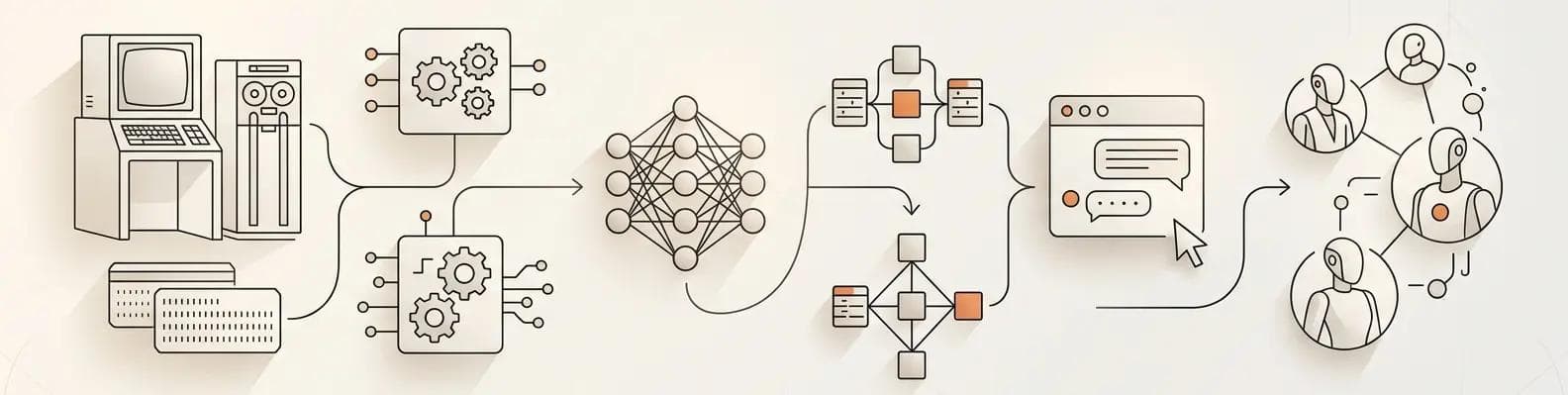
Understanding the Evolution of Language Models
To appreciate why projects like this matter, it helps to understand how language models evolved.
Statistical Language Models
The earliest approaches relied on probability.
Models such as n-grams estimated the likelihood of words appearing together based on observed text. They worked reasonably well for simple tasks but struggled to understand broader context.
Neural Networks
Deep learning changed the landscape.
Recurrent Neural Networks (RNNs) and later Convolutional Neural Networks (CNNs) improved the ability of machines to capture linguistic patterns and generate more coherent responses.
The Transformer Revolution
Everything shifted with the publication of the landmark paper, Attention Is All You Need.
Transformers introduced self-attention mechanisms that allowed models to process relationships between words far more effectively, even across long passages of text.
This breakthrough became the foundation for modern language models.
Pre-trained Models
Another major leap came through pre-training.
Instead of training models separately for every task, researchers trained them on enormous datasets and later adapted them to specific use cases.
Models such as GPT and BERT demonstrated remarkable versatility and dramatically improved performance across NLP tasks.
Large Language Models
The latest stage of this evolution brought us Large Language Models (LLMs).
Trained on massive amounts of information, these models can generate human-like text, reason across topics, summarize information, and support countless business applications.
The possibilities suddenly expanded beyond experimentation into practical adoption.
The Missing Piece: The User Experience
As organizations began adopting LLMs, another realization emerged.
The model alone is not enough.
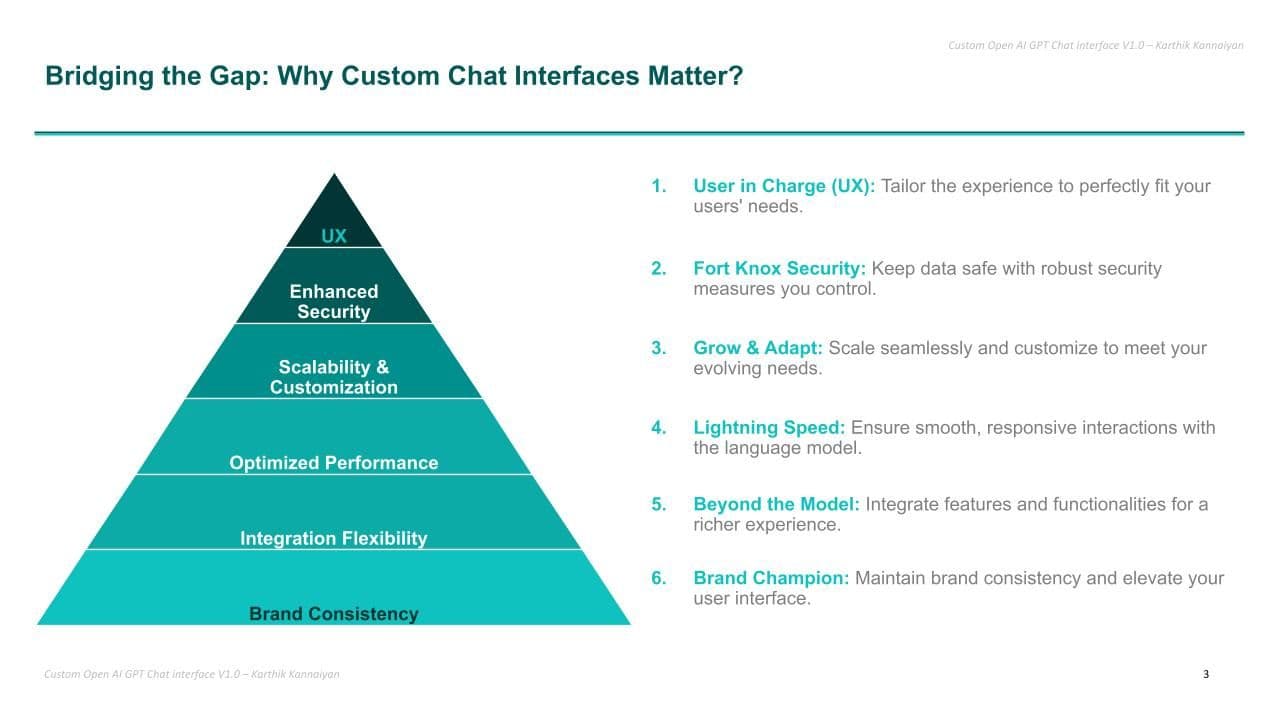
Businesses need experiences that fit their context.
Custom interfaces provide several advantages:
- User experiences designed around specific workflows.
- Greater control over security and access.
- Integration with existing systems and processes.
- Consistent branding and visual identity.
- Improved responsiveness and usability.
- The flexibility to evolve alongside changing needs.
In many ways, the interface becomes the bridge between cutting-edge AI and everyday work.
Building the Custom OpenAI GPT Chat Interface
The application was designed as a lightweight conversational platform powered by OpenAI models.
The goal was simple:
Enable users to interact with powerful language models through an experience they could fully control.
Key Features
- Real-Time Conversations: Users could engage in natural language conversations and receive responses generated instantly through OpenAI's APIs.
- Model Selection: Different GPT models could be selected depending on the user's requirements, enabling experimentation with capabilities and performance.
- Plug-and-Play API Integration: Users could enter their own OpenAI API key directly into the application without complicated setup procedures.
- Chat History Management: Conversations could be saved for future reference, preserving timestamps and contextual information.
- Simple User Experience: Built using Python and the Tkinter framework, the interface emphasized accessibility and ease of use.
The objective was never to create the most sophisticated front end.
It was to learn how people interact with AI systems and identify the elements required to make those interactions meaningful.
Source Code: https://github.com/erakkarthik/Custom-OpenAI-GPT-Chat-Interface
Looking Back
Today, the industry talks about AI agents, copilots, orchestration frameworks, retrieval systems, and autonomous workflows.
Looking back, this project represented my first practical step into that world.
It taught me that successful AI adoption is rarely about the model alone.
It is about designing experiences that people trust.
It is about integrating intelligence into existing workflows.
Most importantly, it is about solving real problems rather than showcasing technology for its own sake.
This project may have started as an experiment, but it fundamentally shaped how I think about AI strategy today.
The future of AI is not simply bigger models.
The future lies in building better experiences around them.