
What is Financial Ratios?
2 Mark answer:
Financial ratios are used to evaluate a company's financial performance and health by dividing one financial metric by another. They are used by investors, analysts, and stakeholders to assess a company's past, current, and potential future financial performance. Different ratios measure different aspects of a company's financial situation, including liquidity, solvency, efficiency, profitability, and valuation. They should be used in conjunction with other financial analysis tools and not relied on alone for investment decisions.
16 Mark answer:
Financial ratios are mathematical expressions that are used to assess a company's financial performance, operating efficiency, and overall financial health. They are calculated by dividing one financial metric by another, and are widely used by investors, analysts, and stakeholders to evaluate a company's past, current, and potential future financial performance.
Financial ratios can be categorized into several types, including liquidity ratios, solvency ratios, efficiency ratios, profitability ratios, and valuation ratios.
Liquidity ratios measure a company's ability to meet its short-term obligations, such as the Current Ratio. Solvency ratios measure a company's ability to repay its long-term debt obligations, such as the Debt-to-Equity Ratio. Efficiency ratios measure how well a company is using its assets to generate revenue, such as the Asset Turnover Ratio. Profitability ratios measure how much profit a company is generating relative to its revenue or assets, such as the Gross Profit Margin. Valuation ratios measure how much investors are willing to pay for a company's stock or assets, such as the Price-to-Earnings (P/E) Ratio.
Financial ratios are an important tool for evaluating a company's financial performance, and can provide valuable insights into its strengths and weaknesses. However, they should be used in conjunction with other financial analysis tools and should not be relied on in isolation to make investment decisions.
Where to find company financials?
2 Mark answer:
You can find a company's financial information on its website, the Securities and Exchange Commission (SEC) website, stock market regulators, financial data providers (such as Bloomberg, S&P Global Market Intelligence, and Yahoo Finance), and in its annual reports. Verify the information with multiple sources to ensure accuracy.
16 Mark answer:
There are several sources where you can find a company's financial information:
- Company's Website: Many companies have an investor relations section on their website where they publish their financial statements and other financial information.
- Securities and Exchange Commission (SEC): If the company is publicly traded, you can find its financial information on the SEC's Electronic Data Gathering, Analysis, and Retrieval (EDGAR) system.
- Stock Market Regulators: Regulators such as the stock exchanges where the company is listed also make financial information available to the public.
- Financial Data Providers: Commercial financial data providers such as Bloomberg, S&P Global Market Intelligence, and Yahoo Finance also collect and provide financial information on companies.
- Annual Reports: Publicly traded companies are required to file annual reports with the SEC, which include their financial statements and other financial information.
It's important to be cautious when reviewing financial information, especially if the information is not sourced directly from the company or from a reliable financial data provider. Always verify the information with multiple sources and make sure you understand the limitations and any biases that may be present.
What is balance sheet and P&L statement?
2 Mark answer:
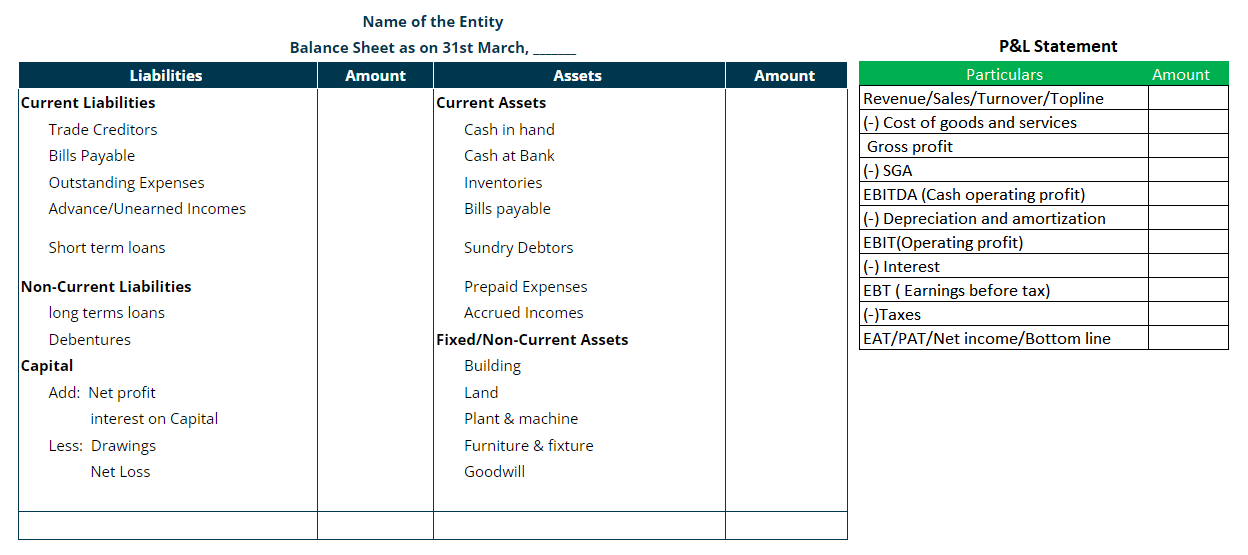
A balance sheet and P&L statement are financial statements used to assess a company's financial performance and position. A balance sheet shows the company's assets, liabilities, and equity at a specific point in time and how they are related. A P&L statement shows the company's revenue, expenses, and resulting profits or losses over a specific period of time. Both statements provide valuable information for investors, analysts, and stakeholders to make informed decisions about the company.
16 Mark answer:
A balance sheet and a profit and loss (P&L) statement are both important financial statements used to assess the financial performance and position of a company.
A balance sheet is a snapshot of a company's financial position at a specific point in time. It lists the company's assets, liabilities, and equity, and shows how these elements are related to each other. The assets of a company are listed in order of liquidity, with the most liquid assets listed first. The liabilities are listed in order of maturity, with the debts due the soonest listed first. The equity section shows the residual interest in the assets of the company after deducting its liabilities.
A P&L statement, also known as an income statement, is a record of a company's revenues, expenses, and resulting profits or losses over a specific period of time, such as a month, quarter, or year. The P&L statement starts with the company's revenue, then subtracts the cost of goods sold, operating expenses, and any other expenses to arrive at the company's net income or net loss. The net income is the profit earned by the company over the period, while a net loss indicates that the company has incurred more expenses than it has earned in revenue.
Both the balance sheet and the P&L statement provide valuable information about a company's financial performance and position. They are used by investors, analysts, and stakeholders to assess the company's past, current, and future financial performance and to make informed decisions about the company.
What is balance sheet?
2 Mark answer
A balance sheet is a financial statement that provides a snapshot of a company's financial position at a specific point in time. It lists the company's assets, liabilities, and equity and shows how these elements are related to each other. The assets are listed in order of liquidity, with the most liquid assets listed first, while the liabilities are listed in order of maturity, with the debts due the soonest listed first. The equity section shows the residual interest in the assets of the company after deducting its liabilities. The balance sheet helps to assess a company's financial strength and stability.
Assets = Liabilities + Equity
or
Assets - Liabilities = Equity
16 Mark answer
A balance sheet is a financial statement that provides a snapshot of a company's financial position at a specific point in time. It lists the company's assets, liabilities, and equity and shows how these elements are related to each other.
The assets section of a balance sheet lists the resources that a company owns or controls, such as cash, accounts receivable, inventory, investments, property, and equipment. Assets are usually listed in order of liquidity, with the most liquid assets listed first.
The liabilities section of a balance sheet lists the debts and obligations that a company owes, such as loans, bonds, accounts payable, and taxes owed. Liabilities are usually listed in order of maturity, with the debts due the soonest listed first.
The equity section of a balance sheet shows the residual interest in the assets of the company after deducting its liabilities. This section includes the company's capital stock, retained earnings, and any other sources of equity.
The balance sheet equation states that the total assets of a company must equal the sum of its liabilities and equity. This equation is always true, regardless of the size or type of the company.
In conclusion, a balance sheet is a crucial financial statement that provides valuable information about a company's financial position, including its assets, liabilities, and equity. It is used by investors, analysts, and stakeholders to assess the company's solvency, liquidity, and overall financial health.
Assets = Liabilities + Equity
or
Assets - Liabilities = Equity
What is P&L statement?
2 Mark answer
A Profit and Loss (P&L) statement is a financial report that shows a company's revenue, expenses, and resulting profits or losses over a specific period of time. It starts with revenue, subtracts cost of goods sold, operating expenses, and other expenses, to arrive at the company's net income or net loss. The P&L statement provides information on a company's financial performance and is used to assess the company's past, current, and future financial performance and make informed decisions.
Revenue > Expense -> Profit
Revenue < Expense -> Loss
16 Mark answer
A Profit and Loss (P&L) statement, also known as an income statement, is a key financial document that summarizes a company's revenue, expenses, and resulting profits or losses over a specific period of time, typically a month, quarter, or year. It provides information about a company's financial performance and is used by investors, analysts, and stakeholders to assess the company's past, current, and future financial position and performance.
The P&L statement typically includes the following elements:
- Revenue: The total amount of money a company earns from its sales or services over the specified period. Revenue is also referred to as "Top Line"
Quantity sold * Unit price = Revenue (R) (1)
- Cost of goods sold (COGS): The cost associated with producing the goods or services sold during the period. This includes direct materials, direct labor, and overhead costs.
- Gross Profit: The amount of revenue remaining after deducting the cost of goods sold. It is calculated as revenue minus COGS.
Revenue - COGS = Gross Profit (GP) (2)
- Gross Margin: is calculated as the difference between revenue and COGS, and represents the amount of money a company has left after accounting for the cost of goods sold. Gross Margin is expressed as a percentage of revenue and indicates the amount of money a company generates from its sales after paying for the direct costs of producing its products or services.
(GP / R) * 100 = Gross Margin % (GM) (3)
- Operating Expense (OE) : (also known as Selling, General & Administrative Expense or SG&A) refers to the indirect costs of operating a business, such as marketing and advertising, salaries, rent, and utilities.
- "Earnings Before Interest, Taxes, Depreciation and Amortization" (EBITDA) is a measure of a company's operating profitability before accounting for interest, taxes, depreciation, and amortization expenses. EBITDA is calculated as revenue minus COGS and operating expenses.
GP - OE = EBITDA (4)
- Depreciation and Amortization (D&A): are non-cash expenses that represent the reduction in value of a company's fixed assets, such as buildings and equipment, over time. D&A is subtracted from EBITDA to arrive at "Earnings Before Interest and Taxes" (EBIT).
EBITDA - D&A= EBIT (5)
- Interest (I) refers to the cost of borrowing money, such as interest paid on loans or bonds. Interest expenses are subtracted from EBIT to arrive at "Earnings Before Taxes" (EBT).
EBIT - I = EBT (6)
- Taxes (T): refers to the amount of money a company owes to the government in taxes. Taxes are subtracted from EBT to arrive at "Earnings After Taxes" (EAT).
EBT - T = EAT (7)
- Profit After Taxes (PAT): is a measure of a company's net income after accounting for all revenues, expenses, and taxes. PAT is also referred to as "Net Income" or "Bottom Line."
The P&L statement provides a comprehensive overview of a company's financial performance and is used to assess the company's financial health and make informed decisions about investments, financing, and operations. However, it should be used in conjunction with other financial analysis tools and not relied on in isolation to make investment decisions.