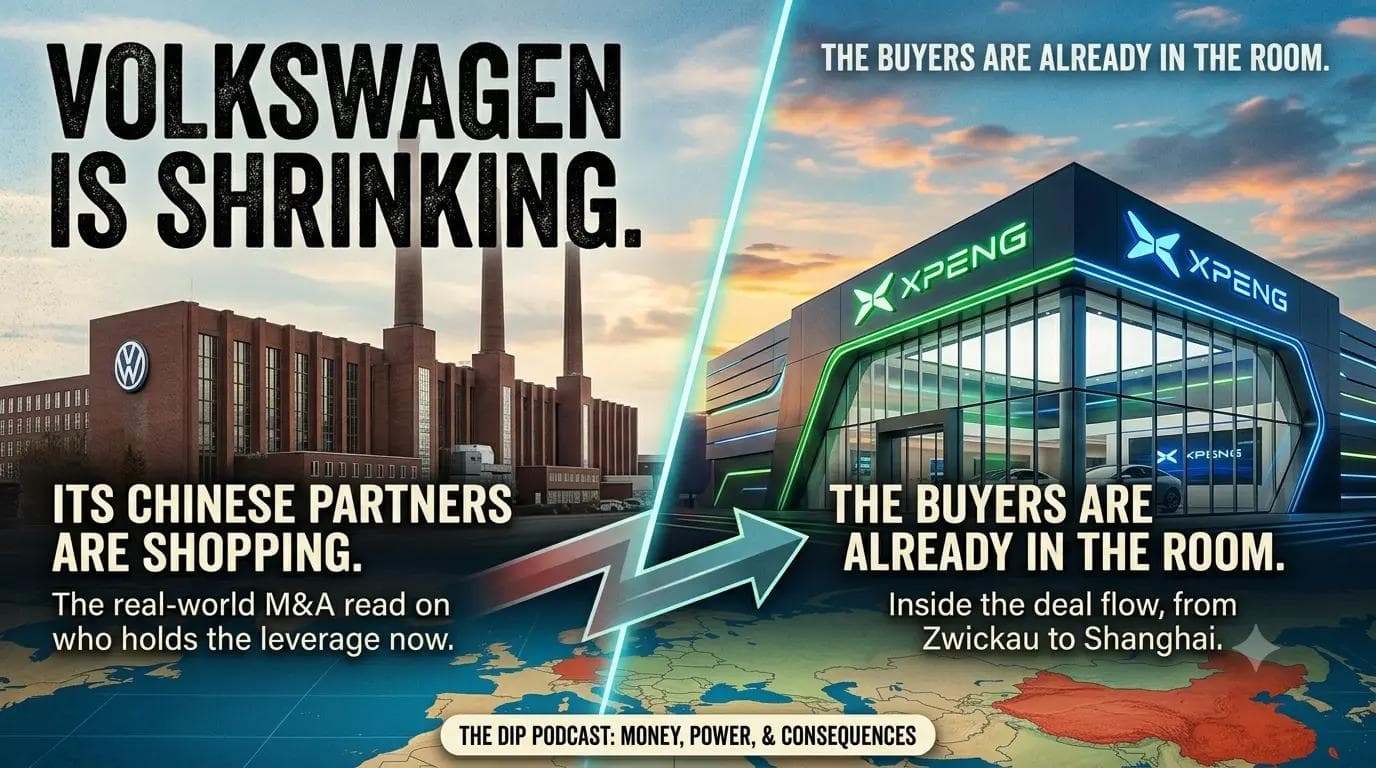
Volkswagen is preparing the largest restructuring in its 89-year history. Up to 100,000 jobs could go. Four German plants are on the review list: Hanover, Zwickau, Emden, and Audi's site in Neckarsulm. Together those plants employ more than 45,000 people.
The plan, first reported by Manager Magazin in late June, would double the 50,000 cuts VW already agreed with unions in late 2024. That earlier deal came with a promise: no German plant closures this decade. Reopening that promise is the explosive part.
On July 9, the plan hit its first wall.
The board meeting that settled nothing
VW's supervisory board met in Wolfsburg while IG Metall organised protests at roughly 20 group sites across Germany. Labour representatives blocked the sweeping restructuring, according to Reuters. When the company spoke afterwards, there was no mention of jobs or plant closures at all.
What VW did announce was still significant. The model lineup will be cut by up to half. Vehicle variants will drop by as much as 75 percent. Annual production capacity comes down to around 9 million vehicles, from roughly 12 million before the pandemic and about 10 million today. These moves did not need board approval, so they went through.
The jobs question did need approval, and here the structure of the company matters more than the strategy.
VW's supervisory board has 19 seats. After a shareholder representative departed in June, labour holds 10 of them. That strips chairman Hans Dieter Poetsch of his usual tie-breaking vote. On top of that sits the Volkswagen Law, which gives the state of Lower Saxony, a 20 percent voting shareholder, effective blocking power over plant decisions. Key resolutions need more than 80 percent approval, not the usual 75.
Read that again from a deal perspective. The CEO of Europe's largest carmaker cannot restructure his own production footprint without the consent of the people whose jobs he wants to cut and the politicians whose regions depend on those jobs. Labour opposition ended the tenures of Herbert Diess in 2022 and Bernd Pischetsrieder in 2006. Oliver Blume knows the history. Analysts put his odds of getting a version of this plan through at about 50-50.
The numbers forcing the issue
The pressure is not abstract. First quarter net profit fell 28 percent to 1.56 billion euros. US tariffs cost the group roughly 4 billion euros a year. China, VW's single largest market, saw sales drop 20 percent in the quarter as BYD and other domestic brands keep taking share. The stock hit a 16-year low.
Industry analyst Stefan Bratzel has framed it in survival terms. Without a sustainable plan now, he argues, VW faces a sell-off and break-up in the 2030s. Ferdinand Dudenhoeffer puts the underlying problem simply: expensive German production against Chinese plants that develop cars in a quarter of the time at a quarter of the cost.
VW's German plants will run at 81 percent of standard capacity this year, per Mobility Global data cited by Reuters. That falls to 73 percent by the end of the decade even if the Osnabrueck plant comes offline. Zwickau, the plant with the best utilisation of the four on the list, drops from around 88 percent now to a projected 42 percent by 2030.
Capacity that cannot be filled has to go somewhere. This is where the story turns.
The buyers are already in the room
While VW looks for ways to shed capacity, its Chinese partners are looking for capacity to buy.
Xpeng is in talks with VW about acquiring a European factory. The Chinese EV maker builds its G6 and G9 for Europe at the Magna Steyr plant in Austria, and that contract line is running out of room. Xpeng's exports hit a record 6,006 vehicles in April, up 62 percent year on year. Blume himself opened the door in late April, saying VW would look at whether there are opportunities for its Chinese partners in Europe.
The two companies are not strangers. VW paid 700 million dollars for a roughly 5 percent stake in Xpeng in 2023. VW is also the first commercial customer for Xpeng's VLA 2.0 smart driving system. The investor is becoming the customer. The customer may become the landlord's tenant, or the buyer of the building.
The same pattern runs through the rest of the group. Audi and SAIC have deepened their partnership around the ringless AUDI brand, built for China on a jointly developed platform, with four new models planned and a dedicated innovation and technology centre in Shanghai. VW's software arm CARIAD runs a joint venture with Horizon Robotics called Carizon, formed with a 2.3 billion dollar VW investment, now developing an AI chip with 500 to 700 TOPS of compute for VW's China vehicles.
Forty years ago, VW brought the engine and the manufacturing know-how to China, and the Chinese partner brought market access. Today the roles have reversed. VW brings the brand, the dealer network, and the market access. The Chinese partners bring the software, the AI stack, the batteries, and the speed.
The M&A read
Three things stand out to me in how this will play.
- First, the constraint is governance, not strategy. Everyone agrees VW has too much capacity and too many models. The fight is over who absorbs the cost of fixing it. When a company needs an 80 percent supermajority and union consent to close a plant, the base case is a negotiated compromise, phased over years, not a clean restructuring. Reports already point to timelines stretching to 2032 for Hanover and 2034 for Neckarsulm. Slow restructurings are expensive restructurings.
- Second, distressed capacity attracts buyers with growth problems, and right now those buyers are Chinese. Xpeng at VW. BYD in talks with Stellantis over underused plants, plus its own factory in Hungary. Leapmotor taking over a Stellantis plant in Madrid. EU tariffs were meant to slow Chinese EV imports. Instead they accelerated Chinese EV manufacturing inside Europe. The tariff wall is becoming a doorway.
- Third, watch the structural moves more than the headcount number. The reported plan includes spinning off the core VW passenger car brand into a separate legal entity. That matters because the Volkswagen Law binds Volkswagen AG specifically. Zwickau sits under Volkswagen Sachsen. Neckarsulm belongs to Audi AG. Entity structure is quietly doing a lot of work here, and it will shape which plants can actually close and which assets could one day be sold.
One caution before anyone reaches for the dramatic scenario. The idea that BYD buys Volkswagen outright makes for a good headline and a bad forecast. No serious reporting supports it, and the same governance structure that blocks Blume would block any hostile buyer far more easily. The realistic path is messier and more interesting: a German champion that keeps its badge and its market access while its technology core migrates, deal by deal, joint venture by joint venture, toward its former students.
The final number may land at 20,000, 50,000, or 100,000. Whatever it is, the direction is set. German industry is restructuring around Chinese technology, on increasingly Chinese terms, and now inside German factories themselves.
That is not a prediction. As of this month, it is the deal flow.
Sources: Reuters, Manager Magazin, Financial Times, Bloomberg, CNBC, Euronews, Audi MediaCenter. Figures as reported July 2026.