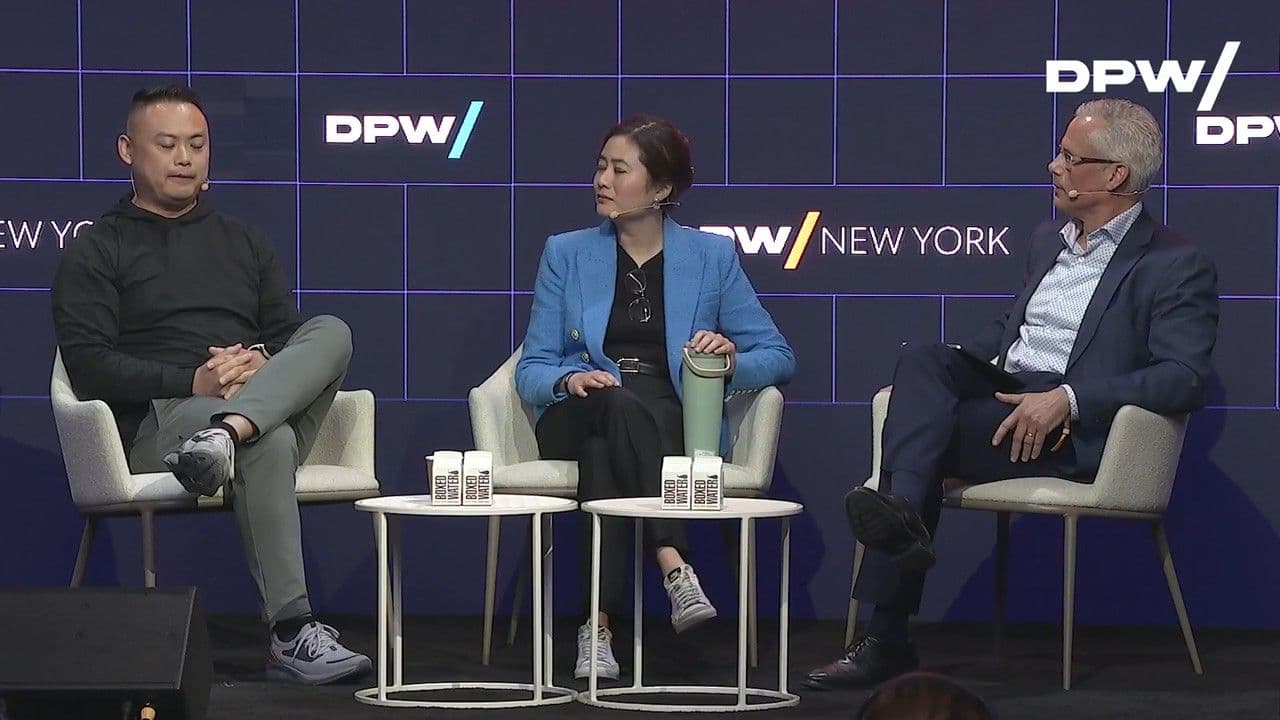
The session title promised a conversation about AI-native teams. What it delivered was something more grounded and more useful: a candid exchange between two procurement leaders who are not theorising about AI-native organisations. They are running them, right now, under conditions that would have seemed implausible five years ago.
Ann Fleishell, VP Procurement at OpenAI, leads a function where the average team member has only ever worked in an AI-native environment. Mike Tsoi leads game engine and technology procurement at EA, a company that has been embedding AI into its products for decades and is now applying that same orientation to the corporate function. Together, moderated by Chris Sawchuk of The Hackett Group, they offered one of the more honest accounts of what it actually means to build and run a procurement team in this moment.
Defining AI-Native: Embedded, Not Optional
The session opened with a question that sounds simple and isn't: what does AI-native actually mean?
Tsoi's answer was behavioural rather than technical. An AI-native team, he argued, is one where AI capability is so embedded in day-to-day work that you would not rebuild the team without it. The test is simple: if you told him tomorrow he could no longer use AI, he would not want to work there. Scale that individual response across a whole function, and you have the definition.
Fleishell framed it as a shift in assumed abundance. At OpenAI, the default assumption is that there is always an intelligent solution available. Always a way to automate the thing that is slowing you down. The privilege of AI-native work, she argued, is not access to a tool, it is the confidence that whatever problem comes at you, you can move toward solving it without waiting for someone else to build the answer. "You can literally be like, this is annoying to me. I'm going to fix this."
For practitioners building toward this state, both framings are instructive. The behavioral definition tells you when you have arrived. The abundance framing tells you what needs to shift culturally to get there.
The Broadening of the Role
When Sawchuk pushed on how roles within procurement need to change to reach AI-native maturity, both panelists pointed in the same direction: the role gets broader, not narrower.
Tsoi used a specific example. One of his team members, a category manager is no longer operating within the traditional boundaries of IT software category management. He is now embedded with risk management, security, and legal teams, understanding the problems each function faces and identifying where procurement's enablement and protection capabilities can add value. The category manager's lane has expanded into something closer to a cross-functional problem solver.
Fleishell made the structural argument: procurement sits at an intersection that almost no other function occupies. It sees every lane of the business. It has context on vendor relationships, spend patterns, risk profiles, and operational dependencies that individual business units do not have individually. AI, by taking on a significant portion of the transactional and administrative load, gives procurement professionals the space to actually use that vantage point to go deeper into the areas they already know well, rather than spending that knowledge on task management.
The force multiplier concept that Tsoi referenced is worth unpacking. A category manager who previously spent the majority of their time on process PO management, contract admin, supplier communication and who now has AI handling the routine layer of that work has not just saved time. They have fundamentally changed what their role is capable of contributing.
Agents on the Org Chart
The session's most provocative moment came when Fleishell suggested something that most organisational designers have not yet caught up with: agents appearing on the org chart as accountable owners of specific task sets, with a human responsible for their performance.
Her logic was practical. Procurement involves a long list of things that, if forgotten, cause cascading failures. The proverbial missing part that stops the car from being built. Every experienced procurement professional carries a mental load of these dependencies, and that load has a real cost in cognitive bandwidth. If an agent can own a defined set of tasks and a human can be accountable for that agent's performance. The human's span of control expands without their capacity being overwhelmed. When the CFO asks a question, the answer is available end to end.
Tsoi was slightly more cautious about agents appearing literally on an org chart, his instinct is that accountability requires a human owner for anything that shows up there. But he agreed on the underlying shift: AI literacy and AI enablement will become embedded in almost every role, even if it does not appear in a job title. The org chart may not change its format, but the nature of what every box on it does will change substantially.
Both panellists pointed to the emergence of new roles, AI enablement leads within functions, people responsible for connecting procurement's needs to the organisation's broader AI strategy, and positions that focus less on a specific category and more on what Fleishell described as simply "enablement." When asked what she enables, the answer is: whatever you need. Because the tools now make that possible.
What Remains Uniquely Human
The session's most resonant exchange came when Sawchuk asked what stays irreducibly human in an AI-native team.
Fleishell named two things: curiosity and empathy. Curiosity because AI returns answers based on what it has been given, and the quality of the outcome depends entirely on the quality of the inquiry. The professionals who will thrive are the ones who keep asking the next question. who treat AI as a starting point rather than a destination, and who are willing to push into the answer to find what is actually useful rather than merely plausible.
Empathy because AI cannot read the room. It cannot pick up tone of voice, body language, or the accumulated context of a working relationship. It cannot know what someone needs in a specific moment and care about the outcome in a way that changes how it responds. The 360-degree human capacity to interpret, to discern, and to apply judgment grounded in genuine care for the other person that is not something AI replicates. It simulates it. There is a difference that anyone on the receiving end of a real conversation versus a generated one can feel.
Tsoi added taste and grit. Taste the ability to look at what AI produces and know what is good, what is appropriate for this context, and what needs to be pushed further requires a depth of professional judgment that only comes from experience and introspection. Grit, because the environment is genuinely uncomfortable right now and getting more so. The pressure on AI to deliver, the pace of change, the uncertainty about what roles will look like in three years these require people who can operate in discomfort without disengaging.
His framing of disengagement as the real risk deserves attention: "I think we're really close to the point where the cost of inaction has outweighed the benefit of being cautious about this. If you're not doing something to educate yourself on AI, it's going to get perceived fairly or unfairly as disengagement. And there's nothing worse than being disengaged."
Measuring the AI-Native Team
When Sawchuk asked how to measure whether an AI-native team is actually succeeding, the answers moved beyond the standard procurement KPIs in an interesting direction.
Tsoi's personal rubric is relationship quality. Is he spending more time building relationships internally and externally than he was before? That is not a metric that fits neatly into a dashboard, but it captures something important: if AI is doing what it should, the human time it frees up should be going to the highest-value human activities, and in procurement, those are almost always relational.
Fleishell acknowledged the hard numbers cycle times, savings, supplier setup speed. OpenAI's requisition-to-PO process, including new supplier onboarding, runs at five days. That is a genuinely remarkable operational figure. But she pushed beyond it to something she called "the vibes" and meant it seriously. Do stakeholders feel the process is easier? Is it transparent enough to navigate without frustration? Do the outlier cases, the ones that take longer than average, feel handled rather than abandoned?
The procurement function has spent years proving its value through metrics. The AI-native era may require proving it through experience through how stakeholders feel about the function, not just what the function produces. That is a harder thing to measure and a more important thing to get right.
The Sung Heroes
The session closed with a question about 2030 what does the AI-native procurement team look like in five years?
Tsoi: "We are finally able to do the things that procurement has always wanted to do develop relationships, be close to the business, fully mature."
Fleishell: "We get to lean into our procurement superpowers. We are vehicles of complexity, of risk, of enablement and we are not always seen for it because there are so many micro things we have to make sure get done. In this new world, we get to be the sung heroes."
The sung heroes. It is a small phrase that carries a significant implication. The AI-native era does not diminish the procurement function it finally gives it the space to be what it has always been capable of being, without the operational weight that has historically made that visibility impossible.
The Practitioner Takeaway
What makes this session's perspective distinctive is not the ambition most procurement leaders are ambitious about AI. It is the specificity. Fleishell and Tsoi are not describing a future state. They are describing what they do every morning, how their teams are structured today, and what they are measuring right now. The AI-native team is not a destination they are planning toward. It is an operating reality they are iterating within.
For practitioners earlier in that journey, the lesson is less about technology adoption and more about orientation. The question is not which tools to deploy. It is whether your team has developed the curiosity to use them well, the empathy to remain irreplaceable, and the grit to operate in an environment that will keep changing faster than any plan can anticipate.